I watch a lot of movies and shows, and I write about most of them. For years that meant juggling pieces that never quite talked to each other: a WordPress blog for reviews, Trakt for watch history, a spreadsheet here and there for the stuff that didn’t fit anywhere else. Every new habit meant another tool, and none of them knew about each other.
So I built Media Hub: one place that’s the center of all of it. Write a review once, see your whole watch history in one spot, and — the part I actually use the most — ask it questions about your own taste instead of trying to remember or scroll back through it. The demo link is here: https://mediahub.adamscave.net/
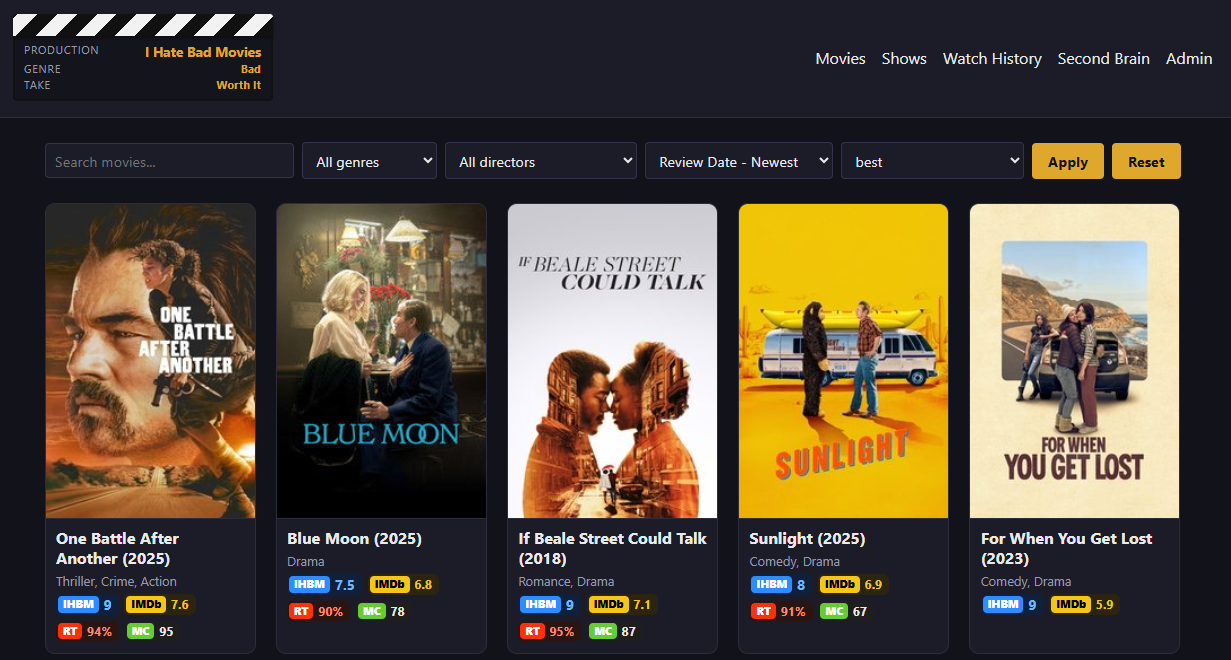
The Media Hub Homepage
One place to write a review
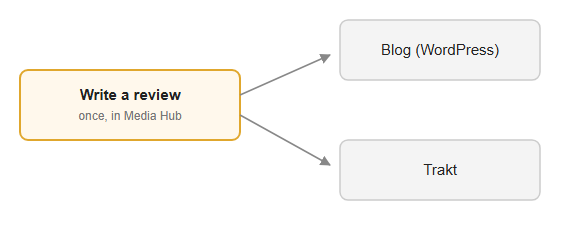
The first rule I set for myself: write a review exactly once. Media Hub is where it’s authored, and from there it publishes out — to the blog, to Trakt — instead of me copy-pasting the same paragraph into two or three places and inevitably letting one of them drift out of sync. If I edit a review later, that edit goes back out too. One source of truth, everything else just reflects it.
Watch history that’s actually mine
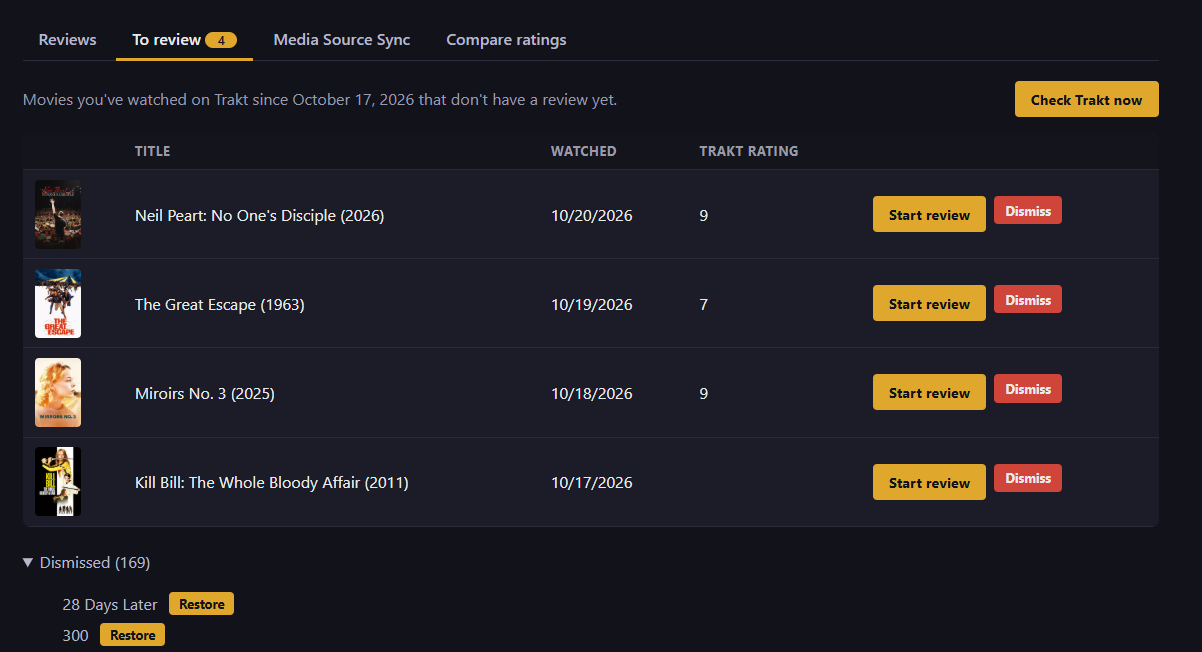
Movies get a review. TV shows mostly don’t — nobody’s writing 800 words on a sitcom episode — but I still wanted to see what I’ve watched and what I thought of it. Media Hub (via an n8n flow that calls endpoints in this app) pulls watch history straight from Trakt rather than asking me to re-enter anything, and it tracks ratings at the level that actually matters for a show: by season, not just one number slapped on the whole series. A show can start strong and fall apart by season three, or the reverse, and I wanted that visible instead of flattened into a single average. It really is fascinating to go back and see the season-by-season rankings of shows that I watched years ago. In many cases, my memory thought that season x was better, but the numbers say that I preferred the episodes in season y more.
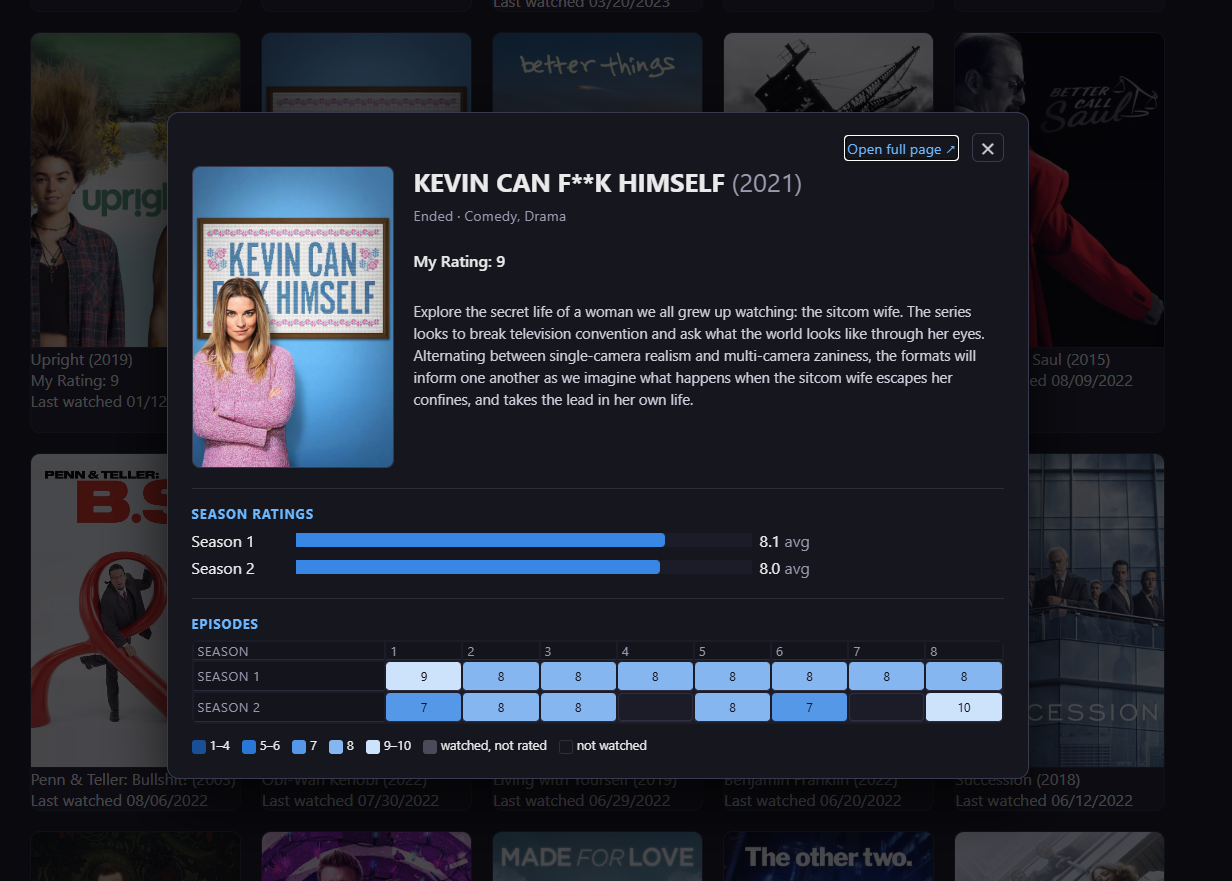
Season-by-season, not one number for the whole run.
A second brain for my own taste
This is the feature I actually built the rest of the app around. Once a few thousand reviews and watch records pile up, your own history stops being something you can just remember — you need to ask it questions. “Which comedies did I actually love this year?” “What did I say about Heat when I rewatched it?” “How many 9s did I give out?” That last one isn’t a search query, it’s arithmetic over your own data, and getting an honest answer (not a guess) out of a chatbot means the system has to know the difference between “find me things” and “count me things” — and reach for a real database query instead of asking a language model to do math in its head.
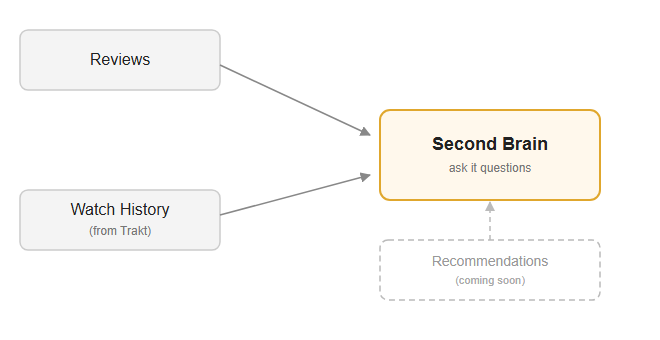 Reviews and watch history feed Second Brain today; recommendations are the next piece to plug in.
Every answer comes back with citations back to the actual review it’s quoting, and it’ll tell you plainly when your reviews don’t cover something rather than making up an opinion you never had. There’s also a connections view — a graph of the directors, actors, genres, and tags running through everything you’ve reviewed, so you can wander from “movies I loved” to “oh, half of these have the same cinematographer” in a couple of clicks.
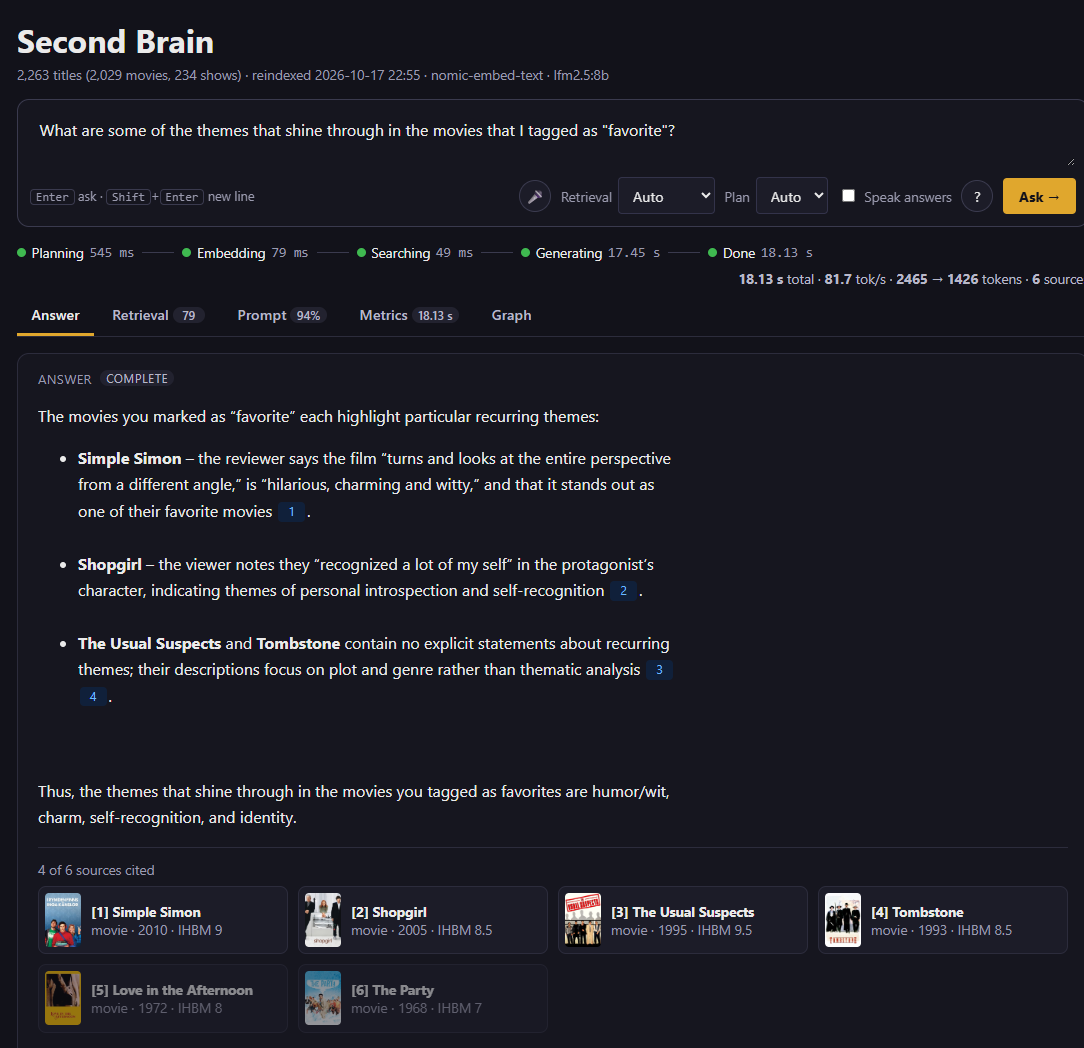
Ask a question, get an answer grounded in what you actually wrote.
(If you want the actual engineering behind this part — hybrid search, citations, the whole retrieval pipeline — I wrote that up separately in the anatomy of a modern RAG pipeline. This post is about what it’s for, not how it’s built.)
Coming next: actually good recommendations
A while back I built a couple of movie recommenders as a side project — using AI to find new movies, trained on the MovieLens dataset. One found people with similar taste and surfaced what they loved; the other found movies similar to ones I already liked. They lived entirely on their own, disconnected from anything I actually watch or review.
That’s the next piece: bringing that logic into Media Hub itself, so recommendations show up right next to the reviews and history they’re based on, instead of in a separate notebook I have to remember exists. “Based on what you’ve rated highly” becomes a real feature of the app, not a one-off experiment.
One small aside: it also talks
Not the headline feature, but worth a mention: Second Brain also takes questions by voice and reads its answers back out loud, using free, local speech services rather than a paid API. Handy when you’d rather ask out loud than type. If you want the details on how that works, that’s its own post — here, it’s just a nice-to-have bolted onto the thing that actually matters: having one place that knows everything I’ve watched and what I thought of it. Go ahead, have a ball with the Megatron voice model that I created.


